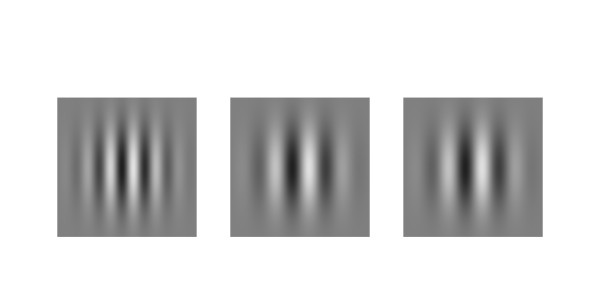
A Gabor patch: sinusoidal gratings modulated by a Gaussian envelope whose properties can be adjusted precisely.
What Are Gabor Patches?
A Gabor patch is a mathematical pattern—specifically, a sinusoidal grating modulated by a Gaussian envelope—that is widely used in visual-perception research. Think of it as a striped pattern that gradually fades into the background. Its properties can be controlled precisely for experiments and training tasks.
You might wonder: why these specific patterns? The answer lies in decades of neuroscience research showing that Gabor patches closely match what many neurons in your primary visual cortex (V1) respond to, which makes them useful for studying early visual processing.
💡 Key Insight
Gabor patches activate V1 neurons efficiently, isolate one feature at a time, and make it easy to adjust difficulty in small, precise steps.
The Nobel Prize-Winning Physics Behind Gabor Patches
The story begins with Dennis Gabor, a Hungarian-British physicist who won the 1971 Nobel Prize in Physics for his invention of holography. But before that revolutionary work, Gabor made another profound contribution: he discovered the fundamental "quantum" of information in signal processing.
In his 1946 paper "Theory of Communication," Gabor applied the tools of Fourier analysis to signals, proposing a fundamental unit of information he called a "logon"—representing a signal confined to a minimal area in the time-frequency plane. The mathematical function that embodies this principle? A sinusoidal wave modulated by a Gaussian function. This is the Gabor function.
🏆 The Uncertainty Principle of Vision
Gabor recognized a fundamental uncertainty principle in signal processing, similar to Heisenberg's principle in quantum mechanics: the more precisely a signal is located in time, the more spread out and uncertain its frequency content becomes, and vice versa.
The Gabor function is the mathematical solution that achieves optimal joint localization in both domains simultaneously. This same principle applies to vision: Gabor patches are the most tightly localized patterns possible in both spatial location and spatial frequency—making them the perfect match for how V1 neurons are organized.
Why This Matters for Vision Training
V1 neurons in your brain function as biological Gabor filters. Each neuron has a "receptive field"—a specific region of your visual field it monitors—and responds to specific patterns within that region. The response properties of these neurons (orientation, spatial frequency, location) are described by functions that are mathematically nearly identical to Gabor functions.
That's why vision scientists find Gabor patches so useful: they're close to the "shapes" early visual neurons respond to.
Why Researchers Use Gabor Patches
Your brain processes vision in stages, starting with the primary visual cortex (V1). V1 neurons—often called "simple cells"—don't respond to complex objects like faces or letters. Instead, they're exquisitely tuned feature detectors, each programmed to fire when it detects specific visual properties:
- Orientation: Each neuron responds to lines at specific angles (horizontal, vertical, diagonal)
- Spatial frequency: Some neurons detect fine details, others respond to coarse patterns
- Contrast: Neurons are sensitive to the difference between light and dark
- Location: Each neuron has a specific receptive field in your visual space
Gabor patches closely match the receptive field properties of V1 neurons, which is why researchers use them to study how these early visual-processing units respond.
⭐ A standard research stimulus
Gabor patches appear throughout visual-perception research in journals such as PNAS and Vision Research, because their properties can be controlled precisely.
How Gabor Practice Works in Visionary
When you train with Gabor patches in Visionary, you're not just looking at random patterns. You're practicing a visual task whose difficulty can be adjusted precisely:
1. Threshold Stimulation
Patterns sit at the edge of what you can see, just barely visible, so every round is a real challenge.
2. Repetition
You repeat the task across sessions. In research, this kind of practice reliably makes people better at the practised task.
3. Adaptive Difficulty
Difficulty adjusts after every answer, keeping each round near the edge of what you can see.
4. What carries over, and what doesn't
Getting better at a Gabor task doesn't automatically mean better everyday vision. Learning is often specific to what was practised (Jeter et al., 2010), which is why Visionary mixes Gabor tasks with letters, words and reading-style exercises.
Why Not Just Use Letters or Text?
This is a great question that many people ask. While Visionary does include letter and text-based training, Gabor patches serve a specific purpose:
Gabor patches = the drill. They isolate one visual feature at a time (tilt, contrast or detail size) so difficulty can be adjusted precisely.
Letter and text tasks = practice that looks like reading, with the letters, words and sentences you read every day.
Think of it as practising scales and then pieces: two kinds of practice in one routine.
🔬 Scientific Precision
Gabor patches allow researchers to precisely control orientation, spatial frequency, contrast, and phase—parameters that can't be controlled with real-world stimuli. This precision is what makes adaptive difficulty possible.
The Research Behind Gabor Patch Training
Gabor patches are widely used in visual-perception research because their properties can be controlled precisely. Examples in the research literature include:
- Polat et al. (2012): A small, nonrandomized study reported changes in trained visual tasks after about 37 half-hour sessions over three months
- Jeter et al. (2010): Learning is often specific to the practised task, and becomes more specific with more training
These findings support continued research, but they do not establish a universal success rate or guarantee everyday reading changes. The 2012 study did not evaluate Get Visionary.
How Visionary Uses Gabor Patches
In your daily training sessions, you'll encounter Gabor patches in various exercises:
- Orientation discrimination: Identifying whether patches are tilted left or right
- Contrast detection: Spotting low-contrast patterns against backgrounds
- Spatial frequency tasks: Distinguishing between fine and coarse patterns
- Lateral masking challenges: Identifying target patches surrounded by flankers
Each task can isolate a different aspect of visual processing. Performance on these exercises is training data, not a medical measurement or a guarantee of change in everyday reading.
Try a Guided Gabor-Pattern Routine
Practice with adaptive visual tasks informed by perceptual-learning research.
Download Visionary TodayResearch-informed; results vary and are not guaranteed.
Frequently Asked Questions
Are Gabor patches safe to look at?
They're ordinary on-screen patterns, much like everyday screen viewing. Take breaks, stop if you feel discomfort, and talk to an eye-care professional first if you have an eye condition or a history of seizures.
How long before the tasks get easier?
Many people find the tasks more familiar within the first few sessions, and the app shows your accuracy session by session. That's progress in the exercise. We don't promise a change in reading or eyesight, or a timeline for one.
Why do the patterns look weird or fuzzy?
That's intentional: the task sits at the edge of what you can see. As you get better at it, the app makes the patterns fainter to keep it challenging.
🎯 Try Gabor Patch Training Right Now
Try Gabor-pattern tasks like those used in perception research, free in your browser. Each demo adapts to your answers with a simple 3-down/1-up staircase.
For a guided daily plan with more than 20 adaptive exercises and progress in each exercise, download Visionary. It's a wellness app, not an eye exam or a treatment.
Frequently Asked Questions About Gabor Patches
What are Gabor patches?
Gabor patches are circular striped patterns made from a sinusoidal grating within a soft Gaussian envelope. Researchers use them because orientation, contrast, and spatial frequency can be controlled precisely.
Do Gabor patches improve vision?
Not in any way shown for a consumer app. Practising with Gabor patches reliably makes people better at the practised task. Small lab studies have reported some carry-over to near-vision measures, but they used intensive protocols and didn't test Get Visionary. Gabor practice doesn't change the eye's optics or replace glasses.
Can Gabor patches help with presbyopia?
A 2012 study reported changes after an intensive three-month protocol. It included 30 trained adults, only three no-practice controls, and no random assignment. It did not test Get Visionary and cannot predict an individual's outcome.
What is the difference between Gabor patches and eye exercises?
Eye exercises (like the Bates Method) target muscles around the eye and have no scientific evidence supporting vision improvement. Gabor tasks instead practice visual perception with controlled patterns. Adults can improve at practiced tasks, but that does not mean the eye's lens changes or presbyopia is cured.
How long does Gabor patch training take to work?
There is no universal timeline. Research protocols vary, and responses depend on the person, task, baseline performance, and consistency. Get Visionary does not guarantee a change in eyesight or reading within a particular period.